
3:00 – 3.05 PM
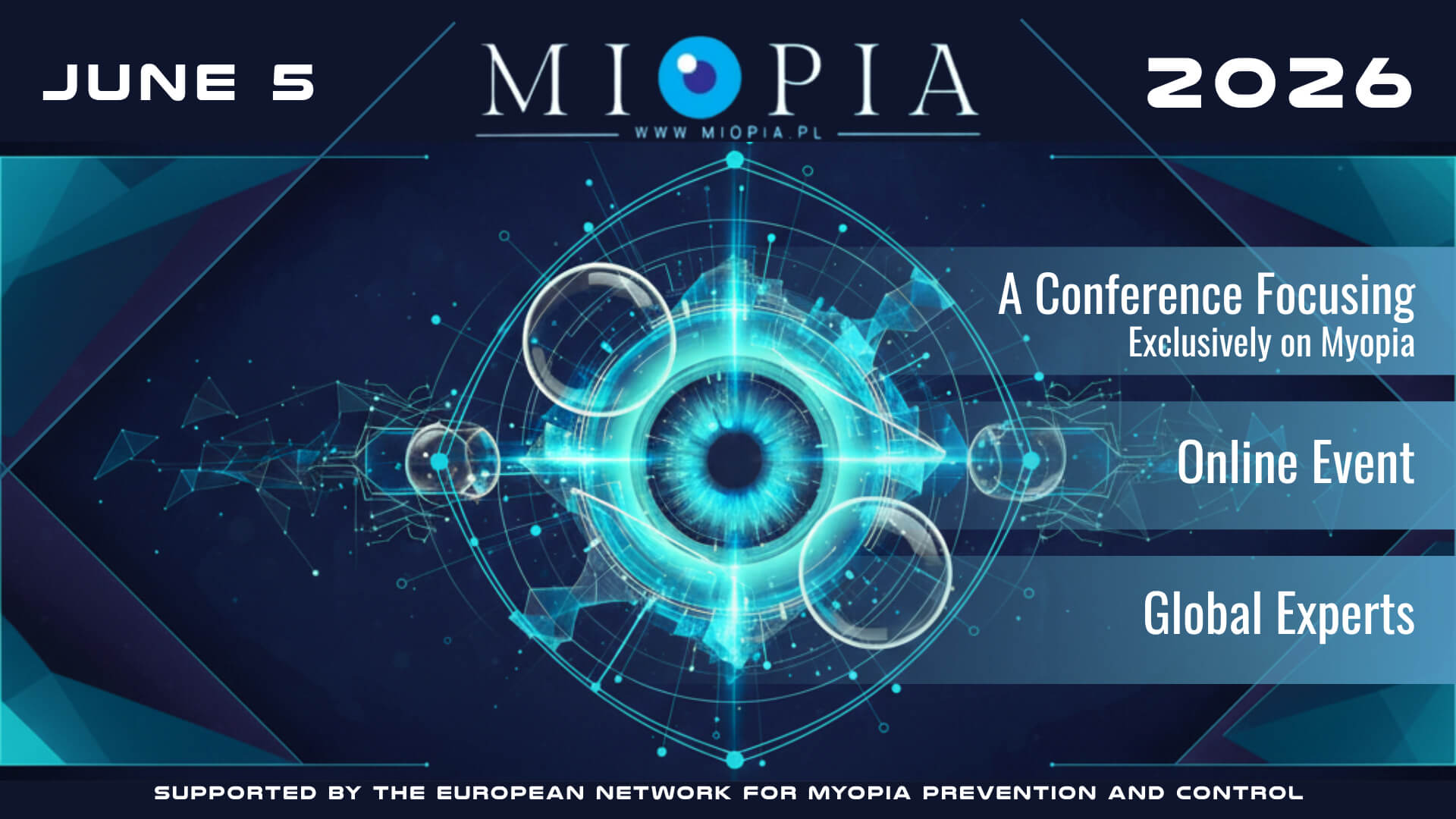
Online Conference Agenda – Myopia 2026
June 5, 2026 | Central European Summer Time (CEST)
Opening of the conference – Prof. Andrzej Grzybowski, MD, PhD, Foundation for Supporting the Development of Ophthalmology “Ophthalmology 21”, University of Warmia and Mazury, Olsztyn, Poland
3.05 – 3.21 PM
Introductory lecture – Myopia prevention and control: it is time to measure what we do, Prof. Serge Resnikoff, MD, PhD, The Chair of the International Myopia Institute
Session I
3.21 – 3.32 PM
Possible effect of Induced Spherical Aberrations (Z04) on Myopia Control by OrthoKeratology. Dr. Andriy Kovalov, MD, PhD. Ophthalmologist Consultant of AILAS Medical Center (Kyiv, Ukraine)
3.32 – 3.41 PM
Indications of favorable structural changes during ortho-k treatment. Dr. Trine Møldrup Jakobsen, MD, PhD, Department of Ophthalmology, University Hospital of Southern Denmark; Institution of Regional Research, University of Southern Denmark, Sønderborg, Denmark
3.41 – 3.50 PM
Twenty Years of Orthokeratology in Real Life: Efficacy, Safety and Predictors of Myopia Progression. Dr. Beata Tapasztó, MD, PhD, Semmelweis University, Department of Ophthalmology, Budapest, Hungary; Semmelweis University, Faculty of Health Sciences, Budapest, Hungary
3.50 – 4.00 PM
The evaluation of methods and the success of optical interventions in a real-world population. Dr. Mhairi Day PhD, the Department of Vision Sciences at Glasgow Caledonian University, Scotland, UK
4.00 – 4.10 PM
Myopia and strabismus. Prof. Pilar Merino Sanz, MD, PhD, Department of Ophthalmology, Hospital Universitario Gregorio Marañón, Madrid, Spain; President of the Spanish Society of Strabismus and Pediatric Ophthalmology (SEEOP)
4.10 – 4.20 PM
Raising the Bar in Myopia Control with MiYOSMART iQ: 12-month randomized controlled clinical trial results. Sylwia Kijewska, Hoya Lens Poland (sponsored lecture)
4.20 – 4.27 PM
Implementing Interdisciplinary Clinical Workflows in Modern Myopia Management, Max Aricochi, M.Sc., Eye Centre Kettenbrücke, Austria, the European Academy of Optometry and Optics.
4.27 – 4.39 PM
Early-life emmetropisation is independent of subsequent refractive error development. Dr. Sotiris Plainis, MSc, PhD, Laboratory of Optics and Vision, School of Medicine, University of Crete, Heraklion, Greece; Honorary Research Fellow at the University of Manchester, UK
4.39 – 4.49 PM
Choroidal thickness and myopia. Dr. Matteo Baldi MD, PhD Department of Neuroscience, Rehabilitation, Ophthalmology, Genetics, and Maternal and Child Health, University of Genoa, Italy.
4.49 – 5.00 PM
Empowering Clinical Excellence with Robust Evidence: Seven Key Facts of Essilor® Stellest® Lenses, Gabi Steenbekkers BOptom. FBCLA, Global Medical Advisor – Myopia, EssilorLuxottica (sponsored lecture)
5.00 – 5.15 PM
Discussion – Speakers and conference participants, moderated by Prof. Pilar Merino Sanz, MD, PhD, Department of Ophthalmology, Hospital Universitario Gregorio Marañón, Madrid, Spain; President of the Spanish Society of Strabismus and Pediatric Ophthalmology (SEEOP)
Session II (5:15 – 7:10 PM)
5.15 – 5.25 PM
Reporting myopia-control efficacy as physiological axial growth and NNT (number needed to treat). Prof. Hakan Kaymak, MD, PhD, I.I.O. GbR, Düsseldorf, Germany; Gottfried O.H. Naumann Institute for Epidemiology and Prevention of Myopia, Saarland University, Homburg, Germany
5.25 – 5.36 PM
Light-Based Interventions to Slow Myopia Progression: Current Evidence. Prof. Carla Lanca, PhD, New York University Abu Dhabi, UAE
5.36 – 5.47 PM
Update on the Prevalence of Myopia in Europe. Prof. Miguel Á. Sánchez-Tena, PhD (Department of Optometry and Vision, Complutense University of Madrid, Spain) and Prof. Cristina Alvarez-Peregrina PhD (Complutense University of Madrid, Spain)
5.47 – 5.57 PM
Association of time spent on near work and outdoors with the prevalence and progression of myopia. Prof. Olavi Pärssinen MD, PhD, CREAM Consortium, MRC Consortium, Finland
5.57 – 6.07 PM
Who Should Be Treated for Myopia? Dr. Jelena Škunca Herman, MD, PhD, Department of Pediatric Ophthalmology and Strabismus, Sestre milosrdnice University Hospital Center, Zagreb, Croatia
6.07 – 6.15 PM
Population study – Myopia screening among first-grade students in Tromsø, Norway. Dr. Aleksandar Stojanovic, MD, PhD, FWCRS, University Hospital of North Norway, Tromsø, Norway; SynsLaser Surgery Clinics, Tromsø and Oslo, Norway
6.15 – 6.25 PM
One-year efficacy and tolerability of 0.05% atropine for myopia control in Estonia, Teele Palumaa, MD, DPhil, Department of Ophthalmology, Emory University, USA, Institute of Genomics, University of Tartu, Estonia
6.25 – 6.35 PM
Do children use myopia lenses as expected, Dr Pablo Concepción-Grande PhD, IOT Lenses and Szajna Soczewki Okularowe (sponsored lecture)
6.35 – 6.45 PM
“Understanding Parental Perceptions and Barriers to Myopia Control Uptake” Dr Síofra Harrington, PhD, FAOI, FEAOO, Technological University Dublin, the Centre for Eye Research Ireland (CERI), Ireland
6.45 – 6.55 PM
“The use of 0.01% atropine in myopia control.” Prof. Andrzej Grzybowski, MD, PhD, Foundation for Supporting the Development of Ophthalmology “Ophthalmology 21”, University of Warmia and Mazury, Olsztyn, Poland (sponsored lecture)
6.55 – 7.10 PM
Discussion – Speakers and conference participants, moderated by Prof. Andrzej Grzybowski, MD, PhD, Foundation for Supporting the Development of Ophthalmology “Ophthalmology 21”, University of Warmia and Mazury, Olsztyn, Poland
7.10 – 7.15 PM
Closing of the conference – Prof. Andrzej Grzybowski, MD, PhD, Foundation for Supporting the Development of Ophthalmology “Ophthalmology 21”, University of Warmia and Mazury, Olsztyn, Poland